Mostrando entradas con la etiqueta Tomate. Mostrar todas las entradas

sábado, 8 de octubre de 2016

Falta de tecnología causa sobreoferta de TOMATE en Paraguay - Lack of technology causes over production of TOMATO in Paraguay

Foto extraída de http://www.ultimahora.com
Ahora mismo el mercado se encuentra con una "superproducción" de tomates, afirmó Baruja, y que se debe a que los productores cosechan en la misma época, aseguró en un contacto con Radio Ñanduti. En un rápido análisis señaló que la sobre abundancia de la hortaliza supera las necesidades del mercado. Esto se debe a que muchos de los productores, carecen de tecnologías que le permita a los agricultores producir en forma escalonada y tener una producción de tomates durante todo el año. Entre esas tecnologías, citó el caso de la ausencia de invernaderos, sistemas de riego, infraestructuras, elementos necesarios para la producción hortícola.

Según señaló, los productores actuales reciben la cooperación del Ministerio de Agricultura, con sus recomendaciones y también con la canalización de sus productos en el mercado local. Prueba de ello es el convenio firmado con la Cámara Paraguaya de Supermercados (Capasu), por la que estos ya adquirieron unos 3500 kilos de tomate. También se encuentra prevista la compra de zanahorias, cebollas entre otros productos del campo.

Por otra parte, señaló que otros productos que se están desarrollando de forma optima son el trigo y el maíz, recientemente una importante cantidad de trigo, se ha exportado a la Argentina mencionó. Por otra parte, señaló que actualmente existe la prohibición de introducir al país productos hortícolas como el tomate debido justamente a la gran sobreoferta existente.
Fuente: http://www.ppn.com.py

sábado, 16 de abril de 2016

Why postharvest quality and performance of ORGANIC PRODUCE is better than in conventionals - Por qué la calidad y el comportamiento en poscosecha de los PRODUCTOS ORGÁNICOS es mejor que la de los convencionales

Photo source: http://1938news.com
Organic standards include a well-defined set of practices and a list of technical tools that are permitted by regulation. Organic products are mainly purchased for their safety and absence of synthetic pesticide residues. Furthermore, a diet based on organic products claims to provide health benefits due to the high nutritional value compounds that are more concentrated in organic products compared to conventional ones. As the scientific basis of the differences between organically- and conventionally-grown fruits and vegetables is under debate, some of the published work, together with some recent unpublished results, will be covered in the present review. In addition, the effect of different approaches to organic horticultural production will be described. 

Many studies have confirmed lower nitrate content, especially in leafy vegetables, and higher antioxidant compounds in organically-grown fruits in comparison to conventional ones. A recent study reported organic kiwifruit as higher in ascorbic acid and total phenol content than conventional kiwifruit. These differences were maintained throughout cold storage. Similarly, in organic grapes, antioxidant-related compounds were significantly higher than in conventionally-grown grapes. Analogous results were obtained with organic strawberries grown in protected conditions. However, conventional products usually result in higher moisture content, and this should be taken into account to confirm the differences on a dry matter basis. 

Possible explanations for the effects of organic farming practices on nutritional quality and postharvest performance of fresh produce are the following: (i) organic amendments provide a high input of exogenous organic matter and of nutrients for a long period; in contrast, mineral fertilizers, allowed only in conventional farming systems, are highly concentrated in nutrients that are directly available for root uptake in a shorter time period; (ii) the use of synthetic pesticides (only possible in conventional agriculture) slows down defence mechanisms against pathogens, with the consequence of favoring primary metabolism; (iii) cultural practices may result in different plant composition and nutritional quality, which in turn influence cold storage performance of the products as these differences, both in fertility and pest management, affect the allocation of secondary plant metabolites (such as ascorbic acid and phenolic compounds).
Source: Francesco Giovanni Ceglie, Maria Luisa Amodio and Giancarlo Colelli. 2016. Horticulturae. Complete review @ http://www.mdpi.com/journal/horticulturae.

martes, 9 de febrero de 2016

Malta efforts to guarantee healthy AGRICULTURAL products - Esfuerzos de Malta para garantizar productos AGRÍCOLAS saludables

Photo source: http://iip.gov.mt/
According to latest figures presented by the European Commission it was informed that only 6% of the agricultural products in Malta had high levels of pesticides. In 2014, the Maltese Authority tested samples of more than 170 food products. Only 10 were found to contain high levels of pesticides and immediately action was taken against those responsible for their production. There were cases where they intervened at a field filled with vines preventing it to be sold in the market, or greenhouses with tomatoes that were stopped its distribution in the market.
Source: Maria Muscat (http://www.tvm.com.mt)

martes, 20 de octubre de 2015

Panama: Consorcios de agricultores analizan la marcha de programas de desarrollo HORTÍCOLA sostenible - Farmer's consortia analyze the progress of programs for sustainable HORTICULTURAL development

Foto: http://www.panamaon.com

Se reúnen productores de El Valle de Antón, El Rincón de Santa María, y Calobre que trabajan en el cultivo de tomate, con los enlaces de los que representan el proyecto del programa Regional de investigación e innovación por Cadenas de Valor Agrícola del IICA, del IDIAP y del MIDA, para conocer la situación actual de los consorcios y definir nuevos caminos para su fortalecimiento y consolidación como una modalidad de desarrollo agrícola sostenible.

¿Qué se busca en este nuevo acompañamiento? Que los lideres analicen las fortalezas y debilidades, oportunidades y desafíos que existen y definir nuevos cursos de acción a cuatro años de iniciado el proyecto y a un año para su final con los actores principales no solo en tomate sino, en yuca, aguacate, y papa.

Posterior a esta convocatoria se establecerán reuniones mensuales de coordinación para todos los consorcios y de esta forma se definen nuevos planes de trabajo encaminados a afianzar los conocimientos de los 4 consorcios distribuidos en las provincias de Herrera, Coclé, Los Santos, Chiriquí, Darién, y Veraguas.
Fuente: http://www.panamaon.com

lunes, 12 de octubre de 2015

Semblance of Ethiopian HORTICULTURAL sector, its great potential and opportunities - Semblanza del sector HORTÍCOLA etíope, su gran potencial y oportunidades

Photo source: https://www.kissfromtheworld.com
Ethiopia has strong potential and competitive edge in agriculture in general and horticulture in particular. The country has 12 major river basins with an annual runoff volume of 122 billion meter cubic of water and an estimated 2,6 – 6,5 billion meter cubic of ground water potential. It is often referred as the water tower of Africa. It has 4 million hectare irrigable land. The horticulture sector has shown rapid growth over the last five years, with cumulative growth of 22%. According to data from Central Statistical Authority (CSA) of Ethiopia fresh fruits and vegetables production in 2013 was estimated to be over 5 million MT.

The Agricultural Transformation Agency (ATA) of Ethiopia estimated that annual domestic market of horticultural products around US $ 900 Million. Smallholder farmers are the principal suppliers of fruits and vegetables, but the commercial horticultural production focusing on high value products is increasing fast. Fruits and vegetables production in the smallholders sector is mainly rain fed, while most commercial farmers use irrigation. According to a report by Ministry of Agriculture (2009), a total of close 0,8 million hectares land (including out grower schemes) has been identified for commercial investment in horticulture of which less than 10% is developed.

Fruits and vegetables are strategic export commodities for Ethiopia. Over the last five years the country earned a total of US $ 170 million. Important export markets for fruits and vegetables are the surrounding countries as Djibouti, Somalia and Sudan. The main products to these countries were non-graded fresh fruit and vegetables such as onion, tomato, potato, banana, mango and avocado. High value graded prepacked vegetables and fresh herbs account for only 11% of the total export. Most of these products are exported to the United Kingdom (UK), United Arab Emirates (UAE) and the Netherlands. During the last five years Ethiopia imported a total of over 148.000 MT processed horticultural products; import has shown a cumulative average growth of 33%. Tomato juice (35%), mixed juice (18%) and pineapple juice (18%) are the top three imported juices to Ethiopia.

The Oromia Regional State produced 42% of the total national horticultural products in 2013. The diverse agroecology, large surface and ground water potential and highly fertile land makes Oromia suitable for almost any type of fruit and vegetable products. Currently, the leading vegetable products in the region are onion, potato, tomato, cabbage and garlic. However production of high valued vegetables such as lettuce, eggplant, cherries, strawberry, fresh beans and peas is increasing with an increasing investment by international and domestic companies. The fruits produced in the region include citrus, grapes, mango, papaya, banana, guava and avocado. Apple is a recent introduction in the highlands of North Shewa. 

Oromia region horticulture matrix (Source: http://www.rvo.nl)
Source: Netherlands Enterprise Agency (http://www.rvo.nl/file/investmentguideoromiapdf)

domingo, 20 de septiembre de 2015

Las principales 12 FRUTAS y HORTALIZAS desarrolladas últimamente en Israel - The top 12 FRUITS and VEGETABLES developed lately in Israel

Melón galia
Desde la primera mitad del siglo XX, los magos agrícolas israelíes se han asociado con la madre naturaleza para llevar nuevas variedades de frutas y vegetales al mercado mundial, desde la calabaza de vívido color hasta los pimientos sin semillas. Cada año, Israel exporta más de $2 mil millones de lo que produce – los tomates son el cuarto mayor producto – y está entre los mejores desarrolladores de variedades del mundo de mejor aspecto, mejor sabor, resistente a las enfermedades y más nutritivas.
Según Harry Paris, un científico senior de la Organización de Investigación Instituto Agrícola Volcani – patrocinado por el gobierno, una de las primeras historias de éxito en esta área es el robusto pepino sin semilla Bet Alpha, introducido en 1936. Sus descendientes en todo el mundo todavía siguen fuertes. Los ananás Yoqne’am y los melones Ha’Ogen, de la década de 1950, también establecen un estándar comercial global.
“Los dos melones y los pepinos han tenido un gran impacto internacional”, dice Paris. “Su calidad inspiró mejoras sucesivas por parte de cultivadores genetistas israelíes. Hoy en día, una incontable variedad [de producción híbrida israelí] ha sido cultivada por profesionales”.
Es probable que se encuentren tipos de frutas y vegetales (así como flores de invernadero), inventados en Israel, que crecen en mayor cantidad en el extranjero que en la tierra de su desarrollo, simplemente porque el pequeño Israel no puede producir en la misma escala que países como los Estados Unidos. Pero la innovación azul y blanca está en cada bocado, no importa donde crezca. ISRAEL21c eligió esta “ensalada” de una docena de las mejores frutas y vegetales de creación israelí. Busque muchos más en su mercado local.

1. El melón Galia, lanzado al mercado en 1974 por los cultivadores Zvi Karchi y Anneke Govers, se convirtió en un éxito multimillonario, en dólares, internacional. Un descendiente de Ha’Ogen, Galia, ha tenido un éxito tan espectacular, dice Paris, porque se ve, huele y sabe bien. Todos estos factores contribuyen a tentar a la gente a probar la fruta y luego volver por más… y más. Los licenciatarios Volcani siguieron desarrollando descendientes adicionales de Galia que son populares en todo el mundo.

2. La calabaza Orangetti spagueti, ahora la única calabaza espagueti vendida en Israel, fue el primer vegetal israelí híbrido cultivado en los Estados Unidos bajo su propio nombre. Su color naranja intenso (en oposición a su primo amarillo pálido) lo hace de mejor aspecto, con mejor sabor y más rico en beta-caroteno y otros antioxidantes. Paris comenzó a desarrollar Orangetti en 1979 y fue lanzado en 1986.
Orangetti tiene mejor aspecto y sabor que otras calabazas spaguetti

3. El nectarina-mango de Ben Dor Fruits & Nurseries tiene forma de corazón con una suave piel. Llevó 10 años perfeccionar la fruta y salió al mercado en junio de 2012 en Israel, el RU y Sudáfrica,. Ben Dor también cultiva frutas de carozo híbridas como el plumegranate (una ciruela de color granada), la ciruela en forma de limón, el melocotón pita y muchas otras.

4. El pomelo híbrido pomelit es otra innovación de Ben Dor. Comercializado en el extranjero como Sweetie, esta jugosa fruta es más dulce y menos ácida que un pomelo, más pequeña que un pomelo y mucho más fácil de pelar. Además, el pomelit ha demostrado reducir el colesterol en la sangre y mejorar la actividad anti-oxidante en el cuerpo.

5. Angello, el primer pimiento sin semillas del mundo, ganó el Premio a la Innovación Fruit Logistica en 2012. El desarrollo del mini pimiento rojo sin semillas comenzó hace seis años en la compañía israelí de semillas Zeraim Gedera. Hasta ahora ha crecido sólo en Israel y España, y dado que impacta en el mercado mundial seguirán variedades adicionales en otros colores.

6. El tomate Black Galaxy fue introducido en los mercados internacionales a principios de 2012, pero ya había tenido gran repercusión en su Israel natal. La esencia de la ensalada oscura fue desarrollada por Tecnological Seeds DM utilizando un pigmento derivado de arándanos. Black Galaxy no sólo tiene aspecto exótico sino que también contiene mayores concentraciones de vitamina C que las variedades de tomates de jardín.

7. La calabaza Goldy zucchini fue desarrollada por el Volcani de Harry Paris y presentado en 1983. “Sigue siendo el zucchini de mejor aspecto, y sigue vendiéndose 30 años después”, dice. Goldy es popular en los principales mercados del exterior, y su color amarillo brillante hace que sea menos húmedo y más sabroso que similares calabazas. Paris recomienda freír rebanadas como chuletas, o usar Goldy en tartas y otros platos de queso, ya que nunca es aguado.

8. Nano Sandía – más dulce que el original, de color ligeramente diferente y no más pesado que tres kilogramos – es un reciente nuevo producto resultado de tres años de desarrollo por parte del Dr. Eyal Vardi, CEO de Origene Seeds. Hishtil Nurseries e Itay Gal, un agricultor del Moshav Ein Yahav, cultivaron los primeros como una prueba y el melón fue un éxito.
Árbol de la albahaca de Hishtil puede crecer en el interior
9. Otra innovación de Hishtil es el mini árbol de albahaca, una solución innovadora al problema de la naturalmente corta vida útil de la hierba. Injertando dos tipos de plantas de albahaca juntos, Hishtil obtuvo una cepa resistente con un tronco robusto y frondosas hojas aromáticas. Puede crecer al aire libre en un clima más cálido y ser llevada al interior durante el invierno.

10. La calabaza bellota TableSugar, presentada por Volcani en 2007 y comercializada por Origene Seeds, quita lo “soso” de este resistente vegetal. Tiene el doble de azúcar que la calabaza bellota común, es la mitad de su tamaño, y tiene una piel verde-negra que aumenta su vida útil y sabor. El sabor de sus castañas asadas ha hecho a TableSugar extremadamente popular. Dice Paris, quien pasó 12 años desarrollándola: “Compren un montón en julio, después manténganlo en la nevera algunos meses para que el almidón se convierta en azúcar. Son más dulces con la edad”. Y no tendrán la enfermedad oídio que aflige a muchas calabazas.

11. Los hermosos racimo (Truss) tomates, comunes en Europa, América del Norte, Japón e Israel fueron posibles por la introducción de genes que prolongan la vida en estanterías por parte de Hazera Genetics en cooperación con BonTom y el grupo de investigación de cultivos vegetales de la Universidad Hebrea. Los científicos de BonTom también están detrás de otros importantes avances del tomate, incluyendo los tomates cherry más dulces y más duraderos que debutaron en la década de los años 1990 y se convirtieron en el estándar mundial.

12. La manzana Anna – desarrollada por Efraín Slor, horticultor de Volcani, y que lleva el nombre de su hija – es una fruta del tipo Golden Delicious para cultivar en zonas donde las temperaturas invernales rara vez bajan hasta la congelación. La mayoría de las variedades de manzana necesitan el frío del invierno para desarrollarse, pero Anna madura a principios del verano y crece bien en climas cálidos como Egipto, Indonesia, el sur de California y el sur de Texas.

Manzanas Anna
Fuentes: Abigail Klein Leichman (diariojudio.com)

domingo, 13 de septiembre de 2015

Pakistani VEGETABLE growers are learning protected farming - Productores de HORTALIZAS paquistaníes están aprendiendo la agricultura protegida


http://static.flickr.com/32/48142991_c59f21e151.jpg
The latest tunnel technology is being introduced among progressive growers of the Punjab to grow off-season vegetables as it is impossible to grow summer vegetables without tunnels during December and January. A spokesman of the agriculture department stated that summer vegetables like cucumber, tomato, sweet chilies, green chilies, pumpkin, sponge gourd, bitter gourd, vegetable marrow, red gourd, eggplant (brinjal), watermelon, musk melon could easily and successfully be grown in low, walk-in and high tunnels.
He said that the tunnel grown vegetables were covered by green fiber sheets to protect these vegetables from severe cold and frost during December and January. He recommended the vegetable growers to get proper training for tunnel farming and start nursery cultivation of tomato, sweet chilies, green chilies, and brinjal from mid September.
Sources: dailytimes.co.pk, www.hordaily.com

domingo, 12 de julio de 2015

Researchers identify plant genes tolerant to drought - Científicos descubren genes vegetales tolerantes a la sequía

Photo from https://es.wikipedia.org

The Centre for Research in Biotechnology (CEIB) of Universidad Autónoma de Morelos (UAEM), Mexico, is investigating the Selaginella lepidophylla plant, commonly known as rock flower, doradilla or rose of Jericho, which has the characteristic of losing up to 95% water when it is not available and fully recovers within 48 hours once nurtured with water, a phenomenon that people call resurrection. Ramon Suarez Rodriguez, head of the Laboratory of Molecular Plant Physiology of the CEIB said that this specimen was being used as a research model to try to transfer the genetic information, that causes its revival, to other plants so they can mimic this phenomenon.

He added that they were mainly seeking the genes that confer the plant drought and dehydration tolerances, and they found out that the trehalose, a sugar which is present in a variety of plants and animals, is what ensures the survival of these species in adverse weather conditions and conferred this resistance characteristic, "we identified the genes involved in the biosynthesis of this sugar to try to mobilize it and transfer it to other plants."

The doradilla grows naturally between southern US and southern Mexico, it is typical of arid areas but can also be found in wet areas. This is a very old plant that belongs to the group of Lycophytas, which have conductors systems, rhizophores instead of roots, no leaves and a microphylls structure with which it manages to do photosynthesis, that difference it from the higher evolutionary levels of plants.

The first models, in which the mobilization and transfer of the genes involved in the biosynthesis of trehalose was performed, were Arabidopsis, a model used by many plant physiologists in the world, and tobacco, as they can both be genetically engineered in a relatively easy process and also grow easily. The results were positive, as researchers discovered that the transfer of genes effectively conferred drought tolerance, as well as tolerance to high or low temperatures and saline water.

It's worth noting that the Laboratory of Molecular Plant Physiology of the CEIB has been working with plants of agronomic interest such as alfalfa, and in collaboration with the University of Chapingo, are generating transgenic maize with these genes that biosynthesize trehalose, additionally to an international project with Brazilian institutions through which they have already generated bean plants. As part of this research, it's also important to highlight the work of Cecilia Calderon Galvan, a doctoral student at the CEIB who is currently working with tomato crops under greenhouse conditions, who will then analyse their behaviour in the open.
Source: www.hortdaily.com

martes, 7 de julio de 2015

México se ha consolidado como el exportador número uno de TOMATE a Estados Unidos - Mexico has become the number one exporter of TOMATOES to the US


México se ha consolidado en una década como el exportador número uno de tomate a los EE.UU. y uno de los principales a nivel mundial, al enviar al extranjero casi 2 millones toneladas de la hortaliza y facturar más de $1,000 millones de dólares a partir de 2006. Manuel Antonio Cázares Castro, presidente del Sistema Producto Nacional Tomate Rojo, afirma que en el país se producen alrededor de 3 millones de toneladas en el ciclo que comprende 12 meses, de septiembre a septiembre, y la meta para este año es superar los 2 millones de toneladas de exportación, ya que en este ciclo que concluye en agosto, estimó que la exportación quedó un 30% inferior a lo proyectado.

Sinaloa se corona como el productor principal, al aportar un 42%, y el resto se divide entre los estados de Baja California, Michoacán, Sonora y Jalisco. Cifras de la Secretaría de Agricultura, Ganadería, Desarrollo Rural, Pesca y Alimentación (Sagarpa) señalan que las exportaciones de la hortaliza han crecido 81% en los últimos 10 años, este aumento supera al de otros productos agropecuarios, como las flores, que sólo se han incrementado 47%, ganado vacuno con un 40%, o el tabaco con un 17%.

"A nivel mundial somos el número uno, ya tenemos alrededor de una década, generamos más de $20,000 millones", señaló el representante. "Los mexicanos somos buenos para cultivar el tomate, la meta es llegar a enviar 2 millones de toneladas al extranjero y elevar 1.6 o 1.7 millones de toneladas la producción nacional". Dentro de las exportaciones totales agropecuarias dicho producto registró una participación del 13.5% durante 2014, y su valor equivale al 0.4% de las exportaciones totales anuales.

Algunos de los países a los que se envían los productos son EE.UU., donde México representa el 80% de las importaciones totales, además de Canadá, y Emiratos Árabes. El experto agregó que la agricultura protegida les ha permitido aumentar la producción de la hortaliza y en este momento el tipo de cambio les ha beneficiado.
Fuente: Alejandra Mendoza (http://elhorizonte.mx)

domingo, 5 de julio de 2015

Growing VEGETABLES without entering the greenhouse - Cultivar HORTALIZAS sin entrar al invernadero


The root scanner give a clear view of root health.

The second year of the Dutch experiment Growing Digitally is halfway through. Wim van der Ende (cultivation adviser at DLV GreenQ) is controlling a crop in an area of about 150m2 entirely from a distance from an office. He has not yet been in the glasshouse and relies entirely on the details that he has from measurements and data in order to control the crop.

Up to now, this control from a distance is going according to plan. They are growing with the variety DR1398TH from De Ruiter Seeds. In a different area of the Improvement Centre, they are also growing this variety as a reference crop. This crop is not being controlled from a distance, but is being monitored by the cultivation adviser in the glasshouse.

The information that is necessary to control a glasshouse from a distance consists of strategic information and monitoring information. For this practical research, we are using the following techniques, sensors and devices:

Strategic information: 

•    Details climate computer
•    Crop registration
•    Images
•    Weight measurements
•    Plant temperature camera

Monitoring information:
•    Paskal weighing system
•    Wireless Value sensors
•    Root scanner

A good example of the monitoring information is that in this research, we are using a root scanner. This has been part of the research since the beginning of this year and aims to show the root quality. With this, we can establish root health with the help of a few roots and the colour of the roots, and detect possible problems on time and take action. According to Van der Ende, the crop is looking good and is ready for the summer. Source: http://www.hortidaily.com

miércoles, 1 de julio de 2015

TOMATES azules y el debate de los transgénicos - Blue TOMATOES and the GMOs debate

Foto de http://www.abc.es
Un miembro del foro socioprofesional eDialogo nos planteaba hace poco la pregunta “¿Son transgénicos los tomates azules?” Como todo lo que lleva la etiqueta transgénica se convierte en asunto polémico, decidimos investigar, y finalmente le respondemos: sí y no. Verán por qué. Los tomates azules surgen, no de un deseo caprichoso del consumidor, sino como iniciativa de varios centros de investigación en diversos lugares del mundo, pero siempre con fines terapéuticos. Las diferencias principales están en el método utilizado para obtenerlos — hibridación convencional o modificación genética — y en la aplicación final de estos tomates.

Entre los equipos obtentores de los frutos transgénicos se encuentra el del Centro de investigaciones John Innes, en Norwich (Reino Unido), que produjo el tomate azul al incorporar genes de Boca de dragón (Antirrhinum majus), una flor con alto contenido antociánico. Según publican estos científicos en Nature Biotechnology, los ratones alimentados con estos frutos transgénicos disfrutaron de mayor longevidad.

Por su parte, el Instituto de Biología Molecular y Celular de Plantas (IBMCP), en Valencia (España), también utilizó biotecnología para crear tomates azules terapéuticos, pero en su caso diseñados para elaborar vacunas y proteínas de valor agregado. Finalmente unos investigadores de la Universidad de Oregón (Estados Unidos), también han desarrollado tomates, no exactamente azules, sino morados, que contienen una sustancia encontrada en arándanos que les confiere propiedades que reducen el riesgo de contraer cáncer y ciertas enfermedades cardiovasculares.

En el lado de los no transgénicos, encontramos a unos investigadores de São Paulo (Brasil), quienes han desarrollado un tomate morado — no transgénico — que podría ayudar a prevenir ciertas enfermedades. Este tomate brasileño es un híbrido entre un tomate común procedente de Chile, y uno silvestre encontrado en las Islas Galápagos. Este tomate posee propiedades antioxidantes que también contribuyen a prevención de enfermedades, incluyendo algunas crónicas y degenerativas. Todo lo anterior parece razonable, pero ¿qué función desempeña el color, y en particular el azul (o morado) en los experimentos? La respuesta en esta ocasión es simple; el color inusual los hace fácilmente diferenciables de otros tomates, para evitar que se comercialicen para consumo alimentario.

La otra pregunta sería ¿por qué utilizar un tomate precisamente para la investigación? De nuevo encontramos que las respuestas también tienen bastante sentido. El fruto de tomate cuenta con la habilidad de generar y acumular gran cantidad de biomasa con facilidad. Además el tomate es un producto relevante en los hábitos alimenticios occidentales, y una fuente natural de nutrientes. Otro punto a su favor como candidato idóneo para los experimentos es la versatilidad en su forma de consumo.

Fuente: Ana Isabel Reho (http://mundoagropecuario.com)

martes, 30 de junio de 2015

Parrillada de VERDURAS, un ícono para los meses calurosos - Grilled VEGETABLES, an icon for the hot months

Una buena brasa o en su defecto una barbacoa o una plancha son herramientas imprescindibles de la cocina de verano. Con la llegada del calor, los guisos contundentes, los platos de cuchara e, incluso, los asados al horno, como que apetecen menos. La gastronomía se vuelve más natural y pegada al terreno, al producto apenas transformado. Y eso es algo que sucede, especialmente, en el caso de verduras y hortalizas.

Las verduras, durante el proceso de cocción a la plancha.
Trabajadas alrededor de una brasa, una barbacoa o encima de una plancha, es en este tiempo cuando más y mejor se disfrutan. Sin duda alguna, la primera opción es la más recomendable, pero también la más complicada de poner en práctica. Las ascuas rusientes de un fuego de sarmientos, encina o roble van a aportar a los ingredientes que empleemos un sabor incomparable, además de resultar muy evocadoras.

Los tres cocineros consultados para hablar de esta preparación coinciden al valorar el buen resultado que se puede conseguir al utilizar una buena brasa y una parrilla, pero también hablan de su complejidad. "Hay que controlar muy bien la intensidad del fuego –comenta Noelia Fuentes, del espacio de ocio La Junquera– porque si es muy alta corres un serio peligro de que se quemen". De ahí que conviene que las ascuas estén un poco atemperadas.

En este establecimiento, donde el verano se vive con especialidad intensidad –a la mesa y en los refrescantes rincones que lo rodean–, la parrillada de verduras es uno de los platos estrella. Además, presumen de que muchas de las hortalizas que emplean las recogen minutos antes en el huerto que tienen en la Fuente de la Junquera. Es el caso, sobre todo, de calabacines, berenjenas, tomates y espárragos trigueros.

La receta que Noelia Fuentes ofrece en estas páginas está pensada para realizar a la plancha, ya que es como resulta más cómoda de hacer en casa. El tomate, el calabacín, la berenjena y las setas son los ingredientes que menos tiempo necesitan, mientras que el pimiento, la cebolla y los espárragos trigueros demandan algunos minutos más de cocinado y son los productos que antes hay que poner sobre la plancha.

En este establecimiento, la parrillada de verduras se culmina con unas escamas de sal y el aliño con un buen aceite de almendras. "Llevamos empleándolo mucho tiempo y a la gente le encanta", asegura Noelia Fuentes. El punto crocante de los frutos secos sobre las hortalizas recién asadas "aporta un contraste de texturas muy interesante, aunque hay clientes que también nos piden la salsa romesco casera que preparamos".

Floren Domezáin, conocido desde hace años como 'el rey de las verduras', acaba de abrir en Madrid su nuevo restaurante después de que en Zaragoza no le fueran muy bien las cosas con el establecimiento Las Raíces. En su currículum presume de haber suministrado hortalizas de Tudela a los cocineros vascos Arzak, Subijana y Berasategui.

Floren conoce bien la materia prima de la que habla porque la ha empleado toda su vida. Además, el recuerdo de una brasa y de las verduras a la parrilla le devuelve a la añorada huerta del Valle del Ebro. Eso sí, reconoce que no es fácil de trabajar y un poco engorrosa porque "no resulta sencillo controlar el calor que desprende". Ni casi muerta ni muy viva. A su juicio, así tiene que ser la intensidad de la brasa para poner las verduras encima.

Para él, el "fondo de armario" de una buena parrillada debe incluir pimiento rojo y verde; cebolleta, "a ser posible de Fuentes de Ebro"; tomate "de un tamaño medio, ni pequeño ni muy grande", y espárragos trigueros. "Lo primero que hay que poner sobre la parrilla es el tomate –explica–; cuando se empieza a arrugar se envuelve en el papel de plata y se deja junto al resto de los ingredientes".

A partir de estos productos básicos, la preparación admite más compañías como pueden ser calabacín, "que aporta una textura muy interesante", berenjena, zanahoria y hasta judías verdes. "Si son tiernas se pueden utilizar perfectamente –comenta–, le dan al conjunto un toque crujiente que está muy bien".

A la hora de cortar las hortalizas, ofrece hasta las medidas que a su juicio son las ideales; sobre todo, de pimientos, berenjenas o calabacines. "A mí me gustan los cortes grandes, de cuatro centímetros de ancho por diez de largo; la cebolla por la mitad y si tiene un tamaño majo, en cuatro trozos".

En el caso de trabajar las verduras sobre una plancha, el tomate, asegura este cocinero, es el que tiene que recibir un tratamiento especial. "Primero lo marco bien por todos los lados y luego le doy un golpe de horno a 180 grados; una vez que lo sacamos del horno hay que envolverlo en papel de plata y dejarlo media hora de reposo". El resto de las hortalizas habría que trabajarlas igual que sobre la brasa pero teniendo en cuenta que el pimiento, los espárragos trigueros y la cebolla necesitan más tiempo que, por ejemplo, el calabacín y la berenjena.

En cualquier caso, "la pureza de una buena parrillada de verduras la marca el tomate, que así preparado no queda ni crudo ni cocido ni frito ni asado…, pero al romperse es el que ejerce de transmisor de sabores entre todos los ingredientes, el que da uniformidad al plato".

Y, para terminar, un buen aceite de oliva virgen extra de Aragón y unas escamas de sal. Para Floren Domezáin, es toda la compañía que demanda esta receta.
Acompañamientos para las verduras
En cualquier caso, el chef aragonés Jorge Algarate sugiere varias posibilidades de aderezos, salsas o aliños a la hora de disfrutar de las verduras asadas. Además de la salsa romesco clásica, que es una de las más utilizadas, él también propone darle mucho protagonismo al tomate. Por ejemplo, aconseja asarlos en el horno a temperatura no muy alta, durante aproximadamente 25 minutos. "Les quitamos la piel, el corazón y los trituramos con un poco de aceite de oliva, soja y sal; queda una salsa de aderezo estupenda".

Otra opción pasa por calentar en una sartén aceite de oliva virgen extra a una temperatura de alrededor de 60 grados. A continuación, se añaden un par de cayenas y sésamo. "Hay que dejarlo un buen rato hasta que el aceite coge el picante de las cayenas; luego se retiran y ya tenemos un interesante aliño para las verduras".

Con frutas también hay posibilidades. Por ejemplo, según este cocinero, "se puede triturar un melocotón en una cazuela hasta conseguir una especie de zumo natural; se calienta a baja temperatura y se añade la punta de una cucharada de café con curry y un toque de canela; se deja enfriar y en el momento de servir se añade a las hortalizas dando un toque muy fresco".

Otra combinación clásica pasa por mezclar un buen aceite de oliva virgen extra, mostaza (de semillas o de Dijon) y miel. Y, por último, sugiere hacer un pesto, pero empleando albahaca en su elaboración. Con varios frutos secos y la albahaca se hace un majado en un mortero añadiendo aceite a medida que lo vayamos preparando. "La albahaca le da un toque muy refrescante a esta salsa", concluye.
Fuente: http://www.heraldo.es 

jueves, 25 de junio de 2015

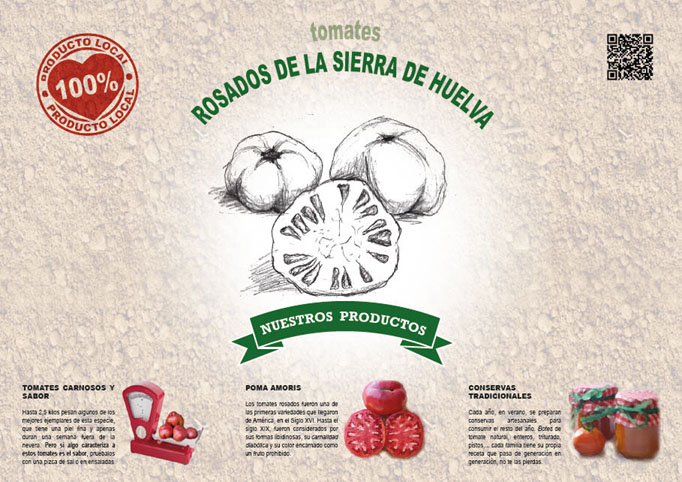
En la Sierra de Huelva, forman un cluster en torno al TOMATE ROSADO - In the Sierra de Huelva, they form a cluster around the PINK TOMATO

Iniciativa dirigida a promocionar uno de los productos icónicos más relevantes de la gastronomía del Parque Natural Sierra de Aracena y Picos de Aroche, e indisolublemente ligado a este municipio: el tomate rosado. 
El tomate rosado de la sierra de Huelva se caracteriza por su tamaño o peso (puede alcanzar hasta 2,5 kg), carnosidad y color y sabor intensos. Fue una de las primeras variedades en llegar de América (siglo XVI)
Los productos icónicos son productos de gran calidad muy ligados a la historia, la tradición artesanal y la etnografía de un territorio. Tienen un gran valor etnográfico, cultural, patrimonial y económico: conservándolos y promocionándolos contribuimos a resguardar el patrimonio inmaterial del territorio y su sostenibilidad económica, a través de la conservación de oficios artesanales. Muchas veces estos productos, a pesar de su calidad, no son conocidos por los visitantes de los territorios. El objetivo de esta iniciativa es que tanto los visitantes como los habitantes del territorio los conozcan, y que ese producto se identifique con el territorio y se convierta en uno de sus productos estrella. Protegiendo este producto se contribuye a conservar esta especie y a proteger la economía del territorio, fundada sobre todo en empresas de carácter familiar y tradicional. 
Esto se concreta en un kit de imagen con elementos promocionales del producto, que se entregarán a los empresarios y empresarias implicados en la cadena de valor: cultivo, tratado, venta y distribución, etc. Este kit de imagen incluye carteles, flyers, salvamanteles y pegatinas. Concretamente, En la Sierra de Huelva se preparan cada verano conservas artesanales para consumirlas el resto del año: natural, triturado, en pisto…
El desarrollo de productos icónicos es una de las acciones desarrolladas por Andanatura en el marco del proyecto CIA-EM: Competitividad e Innovación Artesanal España-Marruecos. CIA-EM es un proyecto de Andanatura, Prodetur y la Diputación de Huelva, cofinanciado en un 75% por el Fondo Europeo de Desarrollo Regional (FEDER), a través del Programa de Cooperación Transfronteriza España-Fronteras Exteriores (POCTEFEX).
Fuente: http://www.besana.es 

martes, 23 de junio de 2015

Combating FRESH AGRIFOOD waste in sub-Saharan Africa - Combatiendo el desperdicio de AGROALIMENTOS FRESCOS en África subsahariana

"Though the mangos have come directly from the farms where they were grown, many of them are bruised. The damage is almost all a result of how the fruit was transported: packed as tightly as possible into thin bags and crammed into trucks that offer no padding as they race over Tanzania's bumpy rural roads"


Photo: africaunchained.blogspot.com
At the bustling Kilombero wholesale produce market in the town of Arusha, Tanzania, traders sort hundreds of pounds of mangos that have just been unloaded from trucks. Traders separate the mangos they'll have to discard or, if they're lucky, sell at a discount to buyers who may be able to turn them into juice. A sprawling, three-foot-high mound of rejected mangos grows by the minute. Brown and black spots speckle the fruits' green skin, orange flesh oozing out through cracks. 

Like much of sub-Saharan Africa, Tanzania produces all kinds of food for local consumption as well as export. Yet here, in the part of the world that can arguably least afford to waste food, a good portion of these crops are lost. Much of the loss happens before the food can be eaten, during the so-called "post-harvest" phase between harvest and the point of sale or consumption. The problem is that the equipment and methods that many small-scale farmers use to process and store their crops are inadequate, so months after the harvest, tons of corn might be infested with insects or contaminated with toxic mold. More perishable crops like fruits and vegetables may become inedible in a matter of days. Long a neglected aspect of the agricultural system in developing countries, this waste stream of food is starting to attract attention from global agriculture organizations and financial institutions, offering hope that the losses can be reduced, and with them rates of rural hunger and malnutrition. 

Food waste in Africa and other developing nations is an entirely different problem than it is in developed regions. In developing regions, often the biggest chunk of food loss — more than 40 percent — occurs during the post-harvest phase, according to a 2011 U.N. Food and Agriculture Organization (FAO) report. But in developed regions, the biggest chunk — again more than 40 percent — occurs at the retail and consumer levels. 

Across sub-Saharan Africa, more than a third of fruits, vegetables, roots, and tubers are lost by the time they are processed or packaged, according to the FAO report, the most recent comprehensive estimate available. More precise estimates vary from year to year and from country to country. In Kenya, pests destroy up to 30 percent of all maize harvested — a total loss of about 162 million tons, according to the government-run Kenya Agricultural Research Institute. Ghana, meanwhile, loses up to 50 % of its main crops of vegetables, fruits, cereals, roots, and tubers, said Joe Oteng-Adjei, the country's Minister for Environment, Science, Technology and Innovation, according to the news service GhanaWeb. 

The food waste problem has been neglected for so long that there's no long-term data to show whether these figures have changed over time. In fact, the FAO and other organizations have acknowledged that even existing estimates are not particularly reliable, because the measurement methods are haphazard at best. What's clear is that food in sub-Saharan Africa is being wasted on a large scale, and any progress in reducing that waste should benefit the region — and even the global food supply — significantly. A World Bank report, also issued in 2011, stated that even a 1 percent reduction in post-harvest losses could lead to annual economic gains of $40 million, much of it going directly to farmers. 

The waste is an economic loss, but it is also a loss of precious nutrition and calories. The World Bank report estimated that the value of annual losses, $4 billion, exceeds the total value of food aid sent to sub-Saharan Africa in the decade up to 2008. Even as international efforts to reduce hunger in the region have increased, most of the dollars spent have focused on boosting crop yields, despite the lack of means for storing extra crops. "More production is not going to be able to fill that gap that we're worried about to feed the world in the future. What we have to do is reduce losses," said Lisa Kitinoja, founder of the Oregon-based, nonprofit Postharvest Education Foundation. 

That is slowly starting to happen. The release of the two 2011 reports by international institutions as influential as the World Bank and FAO served as an indication of the growing interest in solving this problem — and also as a rallying cry that motivated other organizations to get involved. Agriculture research organizations across Africa, including several members of the respected global research consortium CGIAR, have started focusing on ways to reduce crop losses. The Seattle-based Bill and Melinda Gates Foundation and the New York-based Rockefeller Foundation have funded initiatives to study and reduce food waste in developing countries, as have organizations in Europe and elsewhere. 

Just outside Arusha, a women's group is learning to make and can a variety of jams that they can sell in nearby markets: mango and guava, but also more experimental flavors like banana-ginger and even an onion marmalade. It's a sharp learning curve for them. To be able to sell commercially, they have to learn about health and sanitation (for a food-safety certification) in addition to perfecting their jam recipes. On a recent Saturday afternoon, a batch of the banana-ginger jam stewed on a freestanding gas burner in a nondescript church-owned building. The women boiled and sterilized jars as black clouds of bees swarmed the room. Lesson learned: close the windows before making banana jam. 

Ultimately, the women hope to preserve more of their crops to eat throughout the year, and earn a bit of income in the process. The training they received from a local post-harvest consultant is just the kind of thing a growing number of organizations working with rural communities to reduce food waste intends to do. The Postharvest Education Foundation, for example, works with farmers and other agricultural workers around the world to identify projects that can help them make a better living by preserving more of their crops. 

Because people are accustomed to losing so much of their harvest, they often need some kind of inspiration, or motivation, before they even consider trying to reduce waste. For example, the group making jam had seen that another group of women making jam across town was able to sell to the local upscale supermarket. The potential for such a lucrative market made them eager to try it for themselves. "Farmers harvest and they don't store. They want to market and sell and get cash straight away," said Ngoni Nenguwo, post-harvest specialist at the Arusha office of the World Vegetable Center, or AVRDC, an international agricultural-research nonprofit that trained the jam-making women. "It just never seemed an option to preserve better. Waste is just a part of agriculture."  

Faraji Msechu, who farms a small plot a few hours to the south of Arusha, said he never thought about trying to reduce the amount of corn he lost to poor storage. That changed when an organization reached out to him to participate in research on storage gear that could improve upon the polypropylene bags he and most other farmers stored their corn in. "I never had that thinking. I just used the polypropylene bags to store maize, and it was business as usual," he said. As important as the need to transform old habits is the need to improve the storage and processing equipment available in sub-Saharan Africa. There is a quickly-growing array of tools, from forced-air cooling rooms to solar dryers, that can help farmers and processors preserve their harvest in the absence of the grain elevators, refrigerators, and freezers that developed countries rely on so heavily. 

AVRDC has a department devoted to post-harvest research and operates a training center in Arusha to demonstrate equipment for local farmers. One promising example on offer is plastic crates for transportation. AVRDC research has shown that switching from wood-slat to plastic crates can reduce the percentage of tomatoes lost during transport from 53 to 22. Because the plastic crates are smoother and have more even walls, the tomatoes inside don't get scratched, squeezed, or smashed as easily as they do in the wooden ones. Even so, the crates are a tough sell. They are much more expensive than the wooden crates, so they must be shipped back to the farmer for reuse, whereas the wooden crates are used once then broken down for, say, firewood at the end of the journey. 

Compatible Technology International, a Minnesota-based nonprofit, has designed and tested several products to reduce crop losses in various African countries in recent years. The organization recently introduced equipment for processing millet in Senegal that it says captures more than 90 percent of the grain — up from roughly half using traditional methods — while also nearly eliminating contaminants like dirt and debris. But equipment alone isn't the solution, said executive director Alexandra Spieldoch. Also essential is leadership and financial training to help farmers adopt the equipment —something the organization tries to achieve through partnerships with local groups and government agencies. 

Other researchers in Tanzania, Kenya, and a few other countries are studying the potential of plant materials to serve as pesticides during crop storage. If they prove successful, the plant materials may save farmers money while also eliminating the need for potentially harmful synthetic chemicals. 
Efforts like these are all so new that it remains unclear which are likely to be the most effective or easily adopted. What is clear is that in countries like Tanzania, where malnutrition and hunger are as persistent as ever, every ounce of wasted food could have provided beneficial calories for someone. 

In February, during a training course in Arusha for agriculture workers learning to teach farmers better crop storage and processing methods, Kitinoja focused part of a morning on emerging opportunities for post-harvest work. There is a lot of potential throughout sub-Saharan Africa right now, not only for reducing the amount of food that gets wasted, but also for people to make careers out of doing so, she said. "I've been working on this for 30 years," she said. "Three years ago, I couldn't have made this presentation. No one was talking about postharvest." 

Source:Rachel Cernansky (http://news.mongabay.com)

domingo, 21 de junio de 2015

Progresa la construcción de un inmenso complejo de INVERNADEROS en el hostil clima de Kazajstán - Progresses to build a huge complex of GREENHOUSES in the hostile climate of Kazakhstan

A primera vista, la ciudad de Pavlodar en los confines del norte de Kazajstán difícilmente parece un lugar que se asociaría con la producción de tomate. Los largos y fríos inviernos se caracterizan por fuertes nevadas, con temperaturas bajo cero y fuertes vientos penetrantes. Abordando el reto está la especialista holandesa en invernaderos Dalsem, que está a medio camino en la construcción de un set de invernaderos gigantes para contribuir a la autosuficiencia de Kazajstán. 
PTK-Dalsem-greenhouse-overview-2-copy
Soportar estas severas condiciones climáticas significa que el proyecto de invernaderos Pavlodr debe utilizar el tipo correcto de equipos y tecnología para crear condiciones de crecimiento óptimas para la producción de tomateIncluso en climas extremos, se prevé que el complejo de 3,4 ha produzca 1.600 t de tomate al año, junto con una variedad de otros vegetales. “Es una de las regiones más frías en esa parte del mundo con inviernos duros y temperaturas extremadamente frías, pero nuestro objetivo es transformar este complejo en un lugar para la producción en masa de tomate“, dijo Broeren. “Dalsem se especializa en el desafío de construir invernaderos modernos, con calefacción en los países extranjeros en los que tenemos que considerar las condiciones climáticas locales y esto es exactamente lo que estamos haciendo en Kazajstán”, comentó. El desarrollo está a medio camino de construcción y se espera comenzar a plantar en el otoño.
Broeren dijo que una vez terminado, el complejo generará rendimientos máximos mediante el control del clima y el riego de las plantas a través de calefacción técnica, refrigeración, filtración, sombreado y los sistemas eléctricos. Este sistema informático es parte esencial del proyecto, ya que controlará la gestión diaria del invernadero una vez que se termine la construcción y comience la producción, monitoreando todo 24/7, los 365 días del año. También habrá un agrónomo dedicado a organizar la producción y llevar la última tecnología hortícola a otros especialistas de Pavlodar trabajando en el proyecto.
PTK-Kazakhstan
La apuesta por una mayor autosuficiencia
Recientemente, el presidente reelecto de Kazajstán, Nursultan Nazarbayev, ha estado pidiendo una mayor sostenibilidad en los sectores de alimentos, así como potenciar en general la industria agrícola del país dado que grandes cantidades de tierra cultivable están poco desarrolladas, mientras que los recursos y la fuerza de trabajo permanecen sin explotar. En un reciente discurso, en el que destacó las reformas y su “Plan de la Nación”, Nazarbayev citó la importancia de atraer inversores para desarrollar la industria agrícola y su potencial para contribuir a la economía general del país. “Kazajstán es el noveno país más grande del mundo, con una gran cantidad de productos importados que han venido de diferentes países en los últimos años y esto es algo que el país quiere cambiar”, añadió Broeren. “El gobierno quiere trabajar hacia la autosuficiencia y lograr una mayor producción, así que están promoviendo esto a través de todo tipo de esquemas, financiación nacional y tratando de conseguir más financiamiento para este tipo de proyectos agrícolas”, indicó.
La calefacción a carbón, donde la quema de polvo de carbón a alta presión minimiza las partículas de hollín y produce un rendimiento de combustión superior, se utiliza debido a la falta de gas local disponible. Y esta falta de gas significa que los proyectos hacen uso de una caldera de LPG cuya producción de dióxido de carbono con calor residual será re-utilizada en el invernadero.

domingo, 3 de mayo de 2015

More FRUIT and VEGETABLES harvested in Hungary in the last season - Más FRUTAS y HORTALIZAS cosechadas en Hungría en la última temporada

Hungaryʼs fruit and vegetable harvest climbed to 2.97 million tons last year, owing to good weather, the head of professional association FruitVeB said today.
Photo by Tupungato @ http://www.123rf.com
Hungarian farmers harvested 15-17% more vegetables and 26-28% more fruit, Ferenc Ledo told a meeting of FruitVeB. Vegetables grown in the open accounted for 1.4 mln tons of the harvest and greenhouse vegetables for 395,000 tons. The mushroom harvest reached 25,000 tons and 1.15 million tons of fruit was harvested.
Farmers harvested 230,000 tons of peppers, 172,000 tons of tomatoes, 220,000 tons of watermelon, 95,000 tons of green peas, 580,000 tons of cucumbers for pickling and 31,000 tons of green beans.
Fruit farmers harvested 820,000 tons of apples, 85,000 tons of sour cherries, 75,000 tons of plums, 42,000 tons of pears, 47,000 tons of peaches, 35,000 tons of apricots and 17,000 tons of sweet cherries.
The sector was worth HUF 255-260 bln last year, calculated using farm gate prices. Based on retail prices, it was valued at HUF 700 bln-710 bln. The values were down 10-15% from the previous year. Roughly half of Hungaryʼs fruit and vegetables are exported.
Sources: http://www.bbj.hu and www.freshplaza.es

lunes, 23 de marzo de 2015

The Scottish TOMATO industry is finished. Does anybody care? - Escocia no produce más TOMATES, a alguien le importa?

I'm more used to seeing him surrounded - nay, dwarfed - by 20ft tall tomato plants under the greenhouses at Clyde Valley Tomatoes in Carluke. Readers will know that the business he revived two years ago with partner Scott Robertson folded in January despite its high profile and the support of supermarkets, garden centres and farmers' markets across Scotland.


Each retailer had sold its own exclusive - and to my eyes innovative and exciting - selection of the 14 varieties grown by Craig, and the pair were so encouraged by customer demand they launched Clyde Valley Kitchen, a range of soups and condiments using their own tomatoes and fresh produce grown on nearby farms. But in the end they couldn't get the figures to stack up, and called it a day.
It still find the unquestioning acceptance of this sad news a bit strange. It seems to me that hardly anybody batted an eyelid when the brand disappeared from the shelves; there was no outcry or campaign to bring them back. Craig says customers posted their surprise and dismay on Facebook and Twitter, both Waitrose and Scotty Brand said they were saddened and disappointed, and at least one chef declared it a blow that he could no longer name-check Clyde Valley Tomatoes on his menu.
Mostly, though, people were understanding - and, by inference, resigned to the fact that Scotland's long-standing history of large-scale commercial tomato growing is truly at an end (the industry in the Clyde Valley was once so massive they had to export produce to England). Two smaller commercial growers remain in the Clyde Valley and Ayrshire, but they only grow traditional classic round tomatoes for the Glasgow fruit market at Blochairn.
I hate to say it but this worrying lack of reaction suggests to me that consumers don't really care about buying local at their supermarket; if they don't see the distinctive CVT logo, they just move onto the next best thing - most likely from Holland. I'm holding out hope that when farmers' market customers realise they've gone for good they'll hold a belated tomato wake.
It could be, of course, that the increasingly discerning Scottish consumer simply didn't think the Clyde Valley tomatoes were tasty or special enough to justify a small premium. Were they? Weren't they? I'd be interested to know what people think.
Craig himself hasn't wasted much time in finding an outlet for the knowledge and valuable experience gained from his big adventure. He's now a food consultant, with an enviable gig as head chef at the Kelvingrove Cafe in Glasgow's ultra-hip Finnieston quarter, helping steer the menu towards a local, simple, fresh ethos paired with small-batch local botanical gins, vodkas and artisan beers - and away from burgers, chips and lager. And, for the first time in ages, he's properly smiling.
Though the new menu was launched only two weeks ago - a range of small plates and platters using locally sourced ingredients like Botanist gin-cured salmon, smoked duck, baked Dunlop Aiket cheese, soused mackerel, home-made parsley gremolata, whole roast garlic heads and home-baked foccaccia - they've already got through three large venison salamis, and say the demand for chips and burgers has dramatically decreased.
Customers, typically a younger demographic, are staying longer to graze and chat, and at different times of the day. Eating while they drink, as is so common place in other European cities, is helping encourage a more responsible attitude to alcohol consumption - vital in the new era of stricter drink-drive laws.
Craig and KG's owner Barry Oattes reckon they're helping change and modernise the city's lamentable eating-out culture for the better by focusing on the "simplicity of terroir".
Craig says being here is "therapeutic" and that it's good to be part of the new foodie movement in this particular part of Glasgow, where trendy new independent restaurants run by passionate young men hell-bent on showcasing the best of Scotland's natural larder with expert cooking and great service have been opening to rave reviews - and healthy bookings. Between them, Crabshakk, The Finnieston, The Gannet, Ox and Finch, Porter & Rye and Kelvingrove Cafe make up what was recently described as the "powerhouse of good cooking not only in Glasgow but in the whole of Scotland".
He said he was glad he called it a day at Clyde Valley Tomatoes when he did. He and Robertson were so exhausted they simply could not have worked any harder; they were living in a caravan on-site for two years and the relentless regime was "killing" them, he says. When they left and arrived at David's uncle's house on Glasgow's south side, it was like going into a safe house on a victim support scheme. In other words, sheer bliss.
He doesn't regret giving it a go, and would do it all again if he could. Which makes it all the sadder that if this energetic, resourceful and connected pair can't manage it, then the industry in Scotland at this scale is well and truly finished. I just wonder if customers will ask what type of tomato he's cooking with at Kelvingrove Cafe.

martes, 10 de marzo de 2015

New TOMATO variety that eliminates the need for grafting - Nueva variedad de TOMATE que elimina la necesidad de injertar

Olivia, a grape/mini-plum variety from Hazera, produces consistently sized and flavored fruit across all conditions, according to the company. Olivia was developed using traditional plant breeding techniques.


"The grower enjoys the fact that Olivia is easy to grow in all environments and weather. With resistance to Fusarium race 3, Fusarium Crown Rot, and nematodes, among standard resistances, Olivia eliminates the need for grafting and reduces the requirement for plant protection materials. Its vigor gives it a long growing season, producing anywhere from 14 to 25 trusses," says Yair Askira, Nafta Professional Manager at Hazera.

The company mentioned that the packer and shipper benefits from Olivia’s firm fruit, because it holds up well during prolonged transport from field to market and its consistent fruit size makes it easy to pack. Retailers get an attractive, flavorful red tomato with an extended shelf life. As a branded product, Olivia can command a premium price. "Customers get a great-tasting, sweet tomato – its brix is 8-9 percent – that’s great for snacking." Olivia delivers consistency of fruit size and great flavor throughout the growing season. Reinforced resistance reduces exposure to protection materials, making it a better choice for growers and consumers.
Source: http://www.freshplaza.com

lunes, 9 de febrero de 2015

TOMATO: New truss supporter - TOMATE: Nuevo sustentor de racimos

Truss supports are used to support the first plant trusses. The truss supports help to avoid problems associated with the tendency of these first plant trusses to snap.
 
The truss support is fastened around the truss stem, providing support and ensuring better fruit quality and increased production. Truss supports HMO 5.5 mm and HMO 6.0 mm have an open construction and are suitable for early stem growth during which the stems need more air exposure.

Source: Chris Higgins www.hortamericas.com
Article published in http://www.hortidaily.com