Mostrando entradas con la etiqueta Horticultura. Mostrar todas las entradas

viernes, 17 de junio de 2016

First commercially-grown BLACK TRUFFLES for KwaZulu-Natal (South Africa) - Las primeras TRUFAS NEGRAS cultivadas comercialmente en KwaZulu-Natal (Sudáfrica)

The very first black Périgord truffle grown commercially in KwaZulu-Natal, a 97g specimen found on Max Bastard’s Willowdale Farm in the Kokstad area. Photo: Courtesy of Max Bastard 
There has been much excitement on Max Bastard’s Willowdale Farm near Kokstad in KwaZulu-Natal (KZN), following the recent discovery of three black Périgord truffles (Tuber melanosporum). These were the first commercially-grown specimens in KZN.

The first-ever black Périgord truffle to be commercially-grown in South Africa was discovered on a farm near Dullstroom in Mpumalanga in August 2014. This was followed by a similar discovery on a Western Cape farm in August 2015. Bastard’s three truffles were produced in a 20 ha orchard of host trees inoculated with black Périgord truffle spores four-and-a-half years ago.

“Black Périgord truffles are prized for their unique, pungent, earthy aroma, and [are] utilised in the best kitchens and restaurants around the world. They are one of the most expensive culinary ingredients globally, fetching up to US$2,000/Kg (R30,700/Kg),” said Bastard.

Prof Alessandra Zambonelli of the University of Bologna in Italy, told Farmer’s Weekly when the first commercially-grown black truffle was discovered in South Africa, that successful commercial production could be achieved in this country if sufficient host tree orchards were planted. These host trees also needed to be of good quality, and the areas selected for truffle production had to be suitable.
Source: Lloyd Phillips (http://www.farmersweekly.co.za)

martes, 20 de octubre de 2015

Panama: Consorcios de agricultores analizan la marcha de programas de desarrollo HORTÍCOLA sostenible - Farmer's consortia analyze the progress of programs for sustainable HORTICULTURAL development

Foto: http://www.panamaon.com

Se reúnen productores de El Valle de Antón, El Rincón de Santa María, y Calobre que trabajan en el cultivo de tomate, con los enlaces de los que representan el proyecto del programa Regional de investigación e innovación por Cadenas de Valor Agrícola del IICA, del IDIAP y del MIDA, para conocer la situación actual de los consorcios y definir nuevos caminos para su fortalecimiento y consolidación como una modalidad de desarrollo agrícola sostenible.

¿Qué se busca en este nuevo acompañamiento? Que los lideres analicen las fortalezas y debilidades, oportunidades y desafíos que existen y definir nuevos cursos de acción a cuatro años de iniciado el proyecto y a un año para su final con los actores principales no solo en tomate sino, en yuca, aguacate, y papa.

Posterior a esta convocatoria se establecerán reuniones mensuales de coordinación para todos los consorcios y de esta forma se definen nuevos planes de trabajo encaminados a afianzar los conocimientos de los 4 consorcios distribuidos en las provincias de Herrera, Coclé, Los Santos, Chiriquí, Darién, y Veraguas.
Fuente: http://www.panamaon.com

lunes, 12 de octubre de 2015

Semblance of Ethiopian HORTICULTURAL sector, its great potential and opportunities - Semblanza del sector HORTÍCOLA etíope, su gran potencial y oportunidades

Photo source: https://www.kissfromtheworld.com
Ethiopia has strong potential and competitive edge in agriculture in general and horticulture in particular. The country has 12 major river basins with an annual runoff volume of 122 billion meter cubic of water and an estimated 2,6 – 6,5 billion meter cubic of ground water potential. It is often referred as the water tower of Africa. It has 4 million hectare irrigable land. The horticulture sector has shown rapid growth over the last five years, with cumulative growth of 22%. According to data from Central Statistical Authority (CSA) of Ethiopia fresh fruits and vegetables production in 2013 was estimated to be over 5 million MT.

The Agricultural Transformation Agency (ATA) of Ethiopia estimated that annual domestic market of horticultural products around US $ 900 Million. Smallholder farmers are the principal suppliers of fruits and vegetables, but the commercial horticultural production focusing on high value products is increasing fast. Fruits and vegetables production in the smallholders sector is mainly rain fed, while most commercial farmers use irrigation. According to a report by Ministry of Agriculture (2009), a total of close 0,8 million hectares land (including out grower schemes) has been identified for commercial investment in horticulture of which less than 10% is developed.

Fruits and vegetables are strategic export commodities for Ethiopia. Over the last five years the country earned a total of US $ 170 million. Important export markets for fruits and vegetables are the surrounding countries as Djibouti, Somalia and Sudan. The main products to these countries were non-graded fresh fruit and vegetables such as onion, tomato, potato, banana, mango and avocado. High value graded prepacked vegetables and fresh herbs account for only 11% of the total export. Most of these products are exported to the United Kingdom (UK), United Arab Emirates (UAE) and the Netherlands. During the last five years Ethiopia imported a total of over 148.000 MT processed horticultural products; import has shown a cumulative average growth of 33%. Tomato juice (35%), mixed juice (18%) and pineapple juice (18%) are the top three imported juices to Ethiopia.

The Oromia Regional State produced 42% of the total national horticultural products in 2013. The diverse agroecology, large surface and ground water potential and highly fertile land makes Oromia suitable for almost any type of fruit and vegetable products. Currently, the leading vegetable products in the region are onion, potato, tomato, cabbage and garlic. However production of high valued vegetables such as lettuce, eggplant, cherries, strawberry, fresh beans and peas is increasing with an increasing investment by international and domestic companies. The fruits produced in the region include citrus, grapes, mango, papaya, banana, guava and avocado. Apple is a recent introduction in the highlands of North Shewa. 

Oromia region horticulture matrix (Source: http://www.rvo.nl)
Source: Netherlands Enterprise Agency (http://www.rvo.nl/file/investmentguideoromiapdf)

sábado, 10 de octubre de 2015

Dutch HORTICULTURE becoming climate-neutral - La HORTICULTURA holandesa aspira a reducir a cero su impacto en el cambio climático

In 2050 Dutch horticulture will be climate-neutral. Already by 2030 a big step will have been taken. The biggest challenge will be achieved through measures in the greenhouses: more economical production methods, energy-efficient greenhouses, heat recovery and delivery to the greenhouses of sustainable energy (electricity and heat). There will be flexible solutions by district, such as joining a heat-distribution grid, geothermal heat or flexible electricity used at times when there is low-cost solar or wind energy. A CHP plant will be switched on for power supply when electricity is expensive. A number of greenhouse growers will opt for cultivation of specialties that require only an electrical connection for heating. Because electricity in the coming years will become increasingly cleaner and without CO2 production, the glasshouse growers will thus contribute to a neutral climate. The study sketches the pictures of "flexibility" and "all-electric" in the future energy management of greenhouses.


The study "Vision horticulture 2030 climate and energy" has been conducted by CE Delft, commissioned by LTO Glaskracht Nederland and the Ministry of Economic Affairs. The Ministry of Economic Affairs and LTO Glaskracht Nederland have agreed to the Long-term Agreement Energy Greenhouse 2014-2020, to develop a vision for addressing the energy sustainability of the horticultural sector after 2020. In the context of the program Greenhouse as Energy Source, the Ministry of Economic Affairs and LTO Glaskracht Nederland have worked successfully for years on, and led research into, more efficient cultivation methods (The New Cultivation, greenhouses, better lighting, geothermal). As a result the Dutch horticulture industry is one of the most innovative sectors in the area of energy and has a strong lead internationally.


Acreage decrease The report is based on a significant decrease in the area:  20% to 2050 (7,500 ha). "The reason is that there is now a lot of acreage with outdated greenhouses and the assessment is that they will not all be replaced. More than half of the remaining area  (60%) will consist of the cultivation of commodities where a large degree of flexibility can be applied with regard to electricity, heat, production and CO2. The other 40% consists of the cultivation of specialties, products where all-electric greenhouses are dominant. 

Cogeneration
The report also looks at the position of CHP. In the coming years, there are still many opportunities for the use of CHP. The opportunities for the sustainable Bio-CHP are, however, highly dependent on various developments. The availability and cost of suitable biomass is a very important one. But also developing a market model in which the flexibility available to the grower gets a value by which the cost of the durability can be covered is necessary.
The search for clusters of companies (and other sectors) can contribute to an opportunity for a richer rollout of sustainable heat and power.
Source: Karin Tazelaar (www.hortidaily.com). Full report @ 
http://www.ce.nl/publicatie/visie_2030_glastuinbouw_-_energie_en_klimaat/1671  

domingo, 28 de junio de 2015

Yield improvement of CASSAVA in Malawi - Mejoran el rendimiento de la MANDIOCA (YUCA) en Malawi

Photo: https://s-media-cache-ak0.pinimg.com/736x/90/aa/5b/90aa5bff06ad3228124659c2a2b9c51a.jpg


In Malawi (Africa), increasing human population and low productivity of cassava (Manihot esculenta), the second most important food crop after maize, necessitate the intensification of agronomic options for cassava production. Leo Mathias and Vernon H. Kabambe, with Lilongwe University of Agriculture and Natural Resources, conducted a study to evaluate the effects of inorganic fertilizer and cattle manure on cassava growth and yield in Central Malawi. 

The sweet variety Mbundumali with 9-15 months maturity and potential yield of 25 t/ha was used. From the results, tuber fresh yield was significantly increased by application of both cattle manure and inorganic fertilizer, while there was no significant manure x inorganic fertilizer interaction. 

Tuber fresh yield was maximum at 27.6 t/ha with application of cattle manure at 5 t ha-1, however increasing the rate of cattle manure to 10 tha-1 did not increase the tuber yield further. Fresh tuber yield increased from 22.8 to 29.2 t ha-1 with inorganic fertilizer application. Yield without fertility amendments was 21 t ha-1, suggesting that appropriate amendments may raise yields above potential. There were also significant effects of inorganic fertilizer on branches per plant, tubers per plant and tuber length, while manure had no effect on these variables.
Full report: http://www.academicjournals.org/journal/AJPS/article-abstract/55B5C1C53409
Source: http://www.academicjournals.org/journal/AJPS 

jueves, 25 de junio de 2015

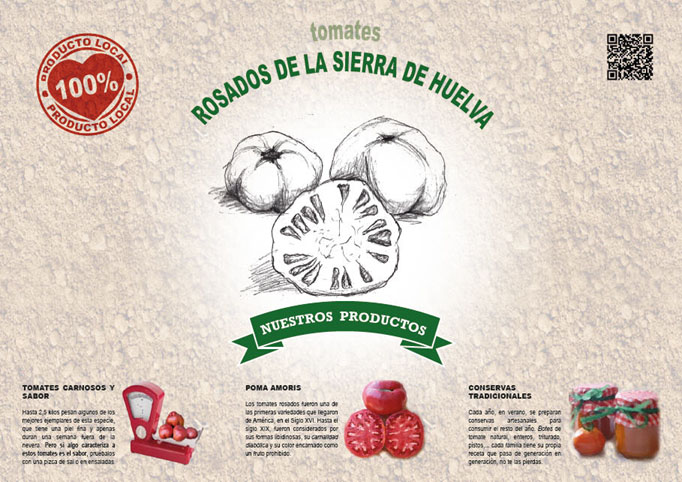
En la Sierra de Huelva, forman un cluster en torno al TOMATE ROSADO - In the Sierra de Huelva, they form a cluster around the PINK TOMATO

Iniciativa dirigida a promocionar uno de los productos icónicos más relevantes de la gastronomía del Parque Natural Sierra de Aracena y Picos de Aroche, e indisolublemente ligado a este municipio: el tomate rosado. 
El tomate rosado de la sierra de Huelva se caracteriza por su tamaño o peso (puede alcanzar hasta 2,5 kg), carnosidad y color y sabor intensos. Fue una de las primeras variedades en llegar de América (siglo XVI)
Los productos icónicos son productos de gran calidad muy ligados a la historia, la tradición artesanal y la etnografía de un territorio. Tienen un gran valor etnográfico, cultural, patrimonial y económico: conservándolos y promocionándolos contribuimos a resguardar el patrimonio inmaterial del territorio y su sostenibilidad económica, a través de la conservación de oficios artesanales. Muchas veces estos productos, a pesar de su calidad, no son conocidos por los visitantes de los territorios. El objetivo de esta iniciativa es que tanto los visitantes como los habitantes del territorio los conozcan, y que ese producto se identifique con el territorio y se convierta en uno de sus productos estrella. Protegiendo este producto se contribuye a conservar esta especie y a proteger la economía del territorio, fundada sobre todo en empresas de carácter familiar y tradicional. 
Esto se concreta en un kit de imagen con elementos promocionales del producto, que se entregarán a los empresarios y empresarias implicados en la cadena de valor: cultivo, tratado, venta y distribución, etc. Este kit de imagen incluye carteles, flyers, salvamanteles y pegatinas. Concretamente, En la Sierra de Huelva se preparan cada verano conservas artesanales para consumirlas el resto del año: natural, triturado, en pisto…
El desarrollo de productos icónicos es una de las acciones desarrolladas por Andanatura en el marco del proyecto CIA-EM: Competitividad e Innovación Artesanal España-Marruecos. CIA-EM es un proyecto de Andanatura, Prodetur y la Diputación de Huelva, cofinanciado en un 75% por el Fondo Europeo de Desarrollo Regional (FEDER), a través del Programa de Cooperación Transfronteriza España-Fronteras Exteriores (POCTEFEX).
Fuente: http://www.besana.es 

viernes, 17 de abril de 2015

“Concepto Mercado”, otra visión de la FRUTIHORTICULTURA - "Market concept", another view of HORTICULTURE

Se editó en estos días el libro “Concepto Mercado”, de Domingo Ramos Bravo, dedicado a analizar en profundidad todas las variables que inciden en la actividad frutihortícola, como así también la cadena desde el productor hasta el consumidor.
 
El libro está dirigido a todo público, consumidores, estudiantes, profesionales y operadores de mercado, y muy especialmente a funcionarios del sector, responsables administrativa o políticamente, de generar normas que garanticen el funcionamiento adecuado, para “poder” producir el alimento para cuatrocientos millones de personas de los que hablan los discursos.

Para el autor parece difícil lograr una interpretación adecuada del funcionamiento del sistema en su conjunto y más difícil hacerlo comprensible para toda la sociedad, pero una vez asimilado el “concepto” el manejo del mercado se simplifica y para eso, es necesario incorporar los factores que intervienen en la problemática de “concepto mercado”: la producción en un extremo, el consumo en el otro y el mercado atravesado por ambos.

“Para estar vivos, lo básico es la alimentación, y si lo básico es la alimentación y el objeto de estudio del concepto mercado es la conectividad entre la producción y el consumo, debemos mantener concatenados el cómo se alimenta el individuo para estar vivo, existen personas que atienden respetuosamente el proceso de ingesta, son los menos, por lo general la gran mayoría se alimenta cuando encuentra la ocasión” , sostiene el autor.

Para Ramos Bravo, en cuanto a las prácticas productivas, las diferencias, son enormes pues el avance más significativo ha sido  gracias a la intervención científica, el uso de agroquímicos, la genética en semillas y la producción bajo cubierta. Pero, sí, el hombre de campo necesita de las leyes de la sociedad para establecer su condición de productor, existen leyes, ordenanzas, disposiciones y obligaciones para toda la sociedad, también se establece la actividad de cada uno de los rubros industriales y comerciales, como así también se conocen y aplican las normas en cuanto a las relaciones laborales de todas las actividades incluidas las relacionadas al trabajo bajo dependencia de los agricultores, pero para sorpresa de todos nosotros aún falta la ley del productor.
Fuente: http://www.todoagro.com.ar

Horticultura urbana en Cuba: viaje de la semilla a la hortaliza - Urban horticulture in Cuba: trip from the seed to the vegetable

Agricultura urbana en Cuba: viaje de la semilla a la hortaliza. Foto: Abel Rojas Barallobre

El Comité Internacional para el Desarrollo de los Pueblos (CISP) es una importante Organización No Gubernamental italiana que presentó en el II Congreso Internacional de Agricultura urbana, suburbana, y familiar sus iniciativas en la producción y conservación de semillas.

La representante en Cuba del CISP, Paola Largui, explicó que desde 1989 trabajan en la Isla en diferentes sectores, dirigidos sobre todo al tema de la agricultura urbana, una prioridad del país: “Nos hemos enfocado últimamente en dos componentes fundamentales, porque son prioritarios para la producción de hortalizas y vegetales: la producción de semillas y de abono orgánico-puntualizó-. Si hay más semillas disponibles para los productores, se debe generar un incremento de la cantidad de vegetales y hortalizas disponibles en el mercado local”.

En este marco, sobresale la cooperación entre los investigadores italianos y el Instituto Nacional de Investigaciones Fundamentales de Agricultura Tropical (INIFAT), intercambio que se ha materializado con proyectos como Proagru. Desde 2012 la iniciativa cuenta con el financiamiento de la Unión Europea.

“Hemos tratado de verlo de manera sistémica para contribuir al abastecimiento de la localidad- declaró Largui -. La idea es que haya una conexión entre investigación y práctica, porque muchas veces los mismos productores tienen soluciones prácticas que pueden aportar a las ciencias, y al mismo tiempo, necesitan retroalimentarse desde la investigación”.

El director del Instituto Nacional de Investigaciones Fundamentales de Agricultura Tropical, Adolfo Rodríguez, apoyó este criterio. Para el Jefe del Programa Nacional de Agricultura Urbana, Suburbana y Familiar en Cuba se trata de un tema primordial: “Contamos con 147 fincas municipales de semillas, de ellas 23 son capaces de producir semillas básicas. Para esto tuvimos que capacitar y demostrar que esto era posible, pues a veces tenemos axiomas que no se cumplen.

En 2014 establecimos un record de producción de semillas básicas, registradas y certificadas –especificó el Doctor en Ciencias- lo que ha posibilitado que contemos con un sistema, para que todo marche. Sin dudas, éste es un tema vital, pues la semilla, acompañada del buen manejo de plantación, es el centro de la agricultura”.

Durante la celebración del cónclave que culminará este jueves, estudiosos vinculados al Comitato Internazionale per lo Sviluppo del Popoli (CISP) mostraron sus proyectos que se distinguen por conceptos de enfoques de género, inclusivos; sostenibilidad ambiental y uso de energías renovables.

Esta ONG acciona en más de veinte países de Asia, África, Europa y América Latina, brindando ayuda humanitaria y apoyando la seguridad alimentaria, desde la cultura y el desarrollo.

Fuente: Ana Isa Vidal Díaz (www.radiorebelde.cu)

sábado, 4 de abril de 2015

The scientist’s duty to reveal findings to the public - El deber del científico es revelar los descubrimientos al público

This a good point to be spread, understood and practiced by all scientists involved in FRUITS and VEGETABLES research 

Photo from www.inta.gob.ar
 
... I believe scientists should sacrifice a bit of the precious time they dedicate to research, shifting their focus also to the dissemination of scientific knowledge with the determination to do so enthusiastically and as simply and clearly as possible...
Popular science should become a new cultural paradigm, a "parallel culture" that enables modern scientists to better pursue both knowledge acquired and their own way of expressing themselves so as to make it as interesting as possible.

Science can aspire to becoming the primary seat for information and training in society, but this change must begin in universities by preparing future scientists, when they turn to others, to speak with absolute clarity. Only in this way will people follow us in our work, support us, and perhaps will value us more…” 
So let us train our brains to what I consider to be the quality that cannot be disregarded by those wishing to communicate effectively,  as I think the true dialectic is not the art of persuading or convincing others but rather  the ability to convey sometimes cryptic and incomprehensible concepts in the simplest possible way.

miércoles, 1 de abril de 2015

Biocontrol in greenhouses is State policy in Canada - El control biológico en invernaderos es política de Estado en Canadá

The Canadian government announced an investment that will enable the Vineland Research and Innovation Centre to deliver effective new and existing biocontrol products such as biopesticide treatments, demonstrate efficient spraying and trapping techniques, and develop a framework for growers to adopt more biological pest management practices.


Member of Parliament Dean Allison, on behalf of Agriculture Minister Gerry Ritz, announced an investment of $143,260 to the Vineland Research and Innovation Centre to conduct research into improving the use of biological controls for pest and disease management for the Canadian greenhouse sector.
The goal is to enhance the sustainability of the Canadian greenhouse industry, delivering economic benefits and growth opportunities along the value chain while enabling the development of more effective and cost-efficient biocontrol products and practices.
 
  • The Vineland Research and Innovation Centre Inc. (Vineland) is a not-for-profit organization incorporated by the province of Ontario in 2007 for the purpose of advancing horticultural research and innovation to support the production of healthy foods in an environmentally sustainable way.
  • Canada has 23 million square metres of production greenhouses which supply both domestic and export markets, employ thousands and are a significant contributor to the Canadian economy.
  • This investment is being made through Agriculture and Agri-Food Canada's AgriInnovation Program, a five-year, up to $698 million initiative under Growing Forward 2.
"Vineland Research & Innovation Center exemplifies one of the great stories of hard-work and dedication, that the Niagara region has to offer. The Horticultural & Agricultural Industries are growing and is a major economic contributor to our riding of Niagara West-Glanbrook and to Canada. With over 100 years of excellence in research and the development of new technologies, our Government is proud to work with the exceptional individuals at Vineland Research & Innovation Center to help cultivate a competitive, modern and world-class agricultural sector for the future." - Member of Parliament Dean Allison.
"The Canadian greenhouse industry is a world leader in the use of biological control, which now underpins most pest and disease management strategies. Today's investment will allow researchers to further address key plant protection and production efficiency priorities identified by the greenhouse sector." - Dr. Michael Brownbridge, Research Director, Horticultural Production Systems.

sábado, 28 de marzo de 2015

Alta tecnología al rescate de pequeños agricultores en África - High technology to rescue small farmers in Africa

La agricultura es uno de los sectores que más personas emplea en África austral y también constituye un pilar para muchas de sus economías. Pero las áreas rurales, donde se sustenta un modo de vida basado en la actividad agropecuaria para la mayoría de los casi 270 millones de habitantes de la región, suelen ser frágiles.

Alta tecnología al rescate de pequeños agricultores en África
Dube AgriZone cuenta con 16 hectáreas de invernaderos, la mayor extensión cultivada bajo un techo de vidrio y con un clima controlado de África. Crédito: FAO

Los países deben hacer frente a varios desafíos en materia de desarrollo. El sector está dominado por el cultivo de la tierra, aunque la cría de animales de granja y otras prácticas agrícolas aumentan paulatinamente. La inseguridad alimentaria aguda y crónica sigue siendo uno de los mayores peligros, y África austral debe hacer frente a enormes desafíos para tratar de transformar y comercializar sus sistemas agrícolas basados en la pequeña agricultura mediante su acelerada integración a los mercados competitivos en un mundo globalizado.

Ese y otros desafíos que afronta el sector fueron el centro del debate de una reunión de tres días que tuvo lugar del 10 al 12 de este mes en la ciudad sudafricana de Durban y que reunió a autoridades y expertos de la Organización para la Alimentación y la Agricultura (FAO). El encuentro terminó con un llamado a priorizar la asociación amplia y a construir sinergias para ofrecer a los países un apoyo efectivo y eficiente para la actividad agrícola.
El coordinador para África austral de la FAO, David Phiri, reiteró la importancia de que los distintos sectores trabajen juntos, aprovechando el encuentro anual que procura ofrecer una plataforma de debate e intercambio de información sobre buenas prácticas y el desarrollo general de los programas de la agencia en la región. “Lograr la seguridad alimentaria y nutricional en África austral es un gran desafío, demasiado grande para que lo afronte solo cualquier gobierno o la FAO”, señaló. “Así como los gobiernos de los países en desarrollo y ricos deben involucrarse, también deben hacerlo la sociedad civil, el sector privado y las agencias internacionales”. “Por encima de todo, es necesario empoderar a la gente misma para que gestione su propio desarrollo”, subrayó.
Como ejemplo de las mejores prácticas que analizó el foro, los participantes realizaron una visita de campo a las instalaciones de Dube AgriZone, una iniciativa de desarrollo agrícola de alta tecnología, promovida por el gobierno de la provincia sudafricana de KwaZulu-Natal. El proyecto procura estimular el crecimiento de los productos perecederos y lograr una mejor producción agrícola, de calidad consistente, todo el año, así como mejorar la gestión de enfermedades y pestes. Las instalaciones, ubicadas estratégicamente 30 kilómetros al norte de esta ciudad costera, actualmente cuentan con 16 hectáreas de invernaderos, lo que la convierte en la mayor extensión cultivada bajo un techo de vidrio y con un clima controlado en África.
El principal objetivo es la producción de verduras y flores que duran poco en los puestos de venta y que requieren un transporte inmediato tras la cosecha para su distribución, tanto en el mercado interno como en el externo. Además de los invernaderos, el recinto ofrece almacenes para empaquetar después de la cosecha, un centro de empaquetado y distribución, un vivero y el Dube AgriLab, un laboratorio complejo para el cultivo de tejido vegetal.
En Dube AgriZone se procura proteger el ambiente mediante prácticas “verdes” para disminuir su impacto ambiental como la cosecha de agua de lluvia, el uso de energía solar, la gestión de residuos in-situ y el cultivo de plantas autóctonas para los esfuerzos de rehabilitación. Además, ofrece a los cultivadores la posibilidad de lograr una mejor cosecha, una calidad consistente, gestión de enfermedades y pestes y una producción a lo largo de todo el año con la perspectiva de mejorar la sostenibilidad y mejorar la competitividad agrícola.
“Nunca hubiera podido montar un lugar así y producir a la escala actual de no haber sido por la innovadora AgriZone”, destacó Derrik Baird, propietario de Qutom Farms, que actualmente produce 150.000 pepinos en el invernadero arrendado a AgriZone. “El centro de alta tecnología con varias instalaciones necesarias, como el transporte y el flete, nos permitió concentrarnos en la producción de pepinos a un costo mucho menor que en los otros lugares que habíamos probado”, explicó.
La asociación entre el gobierno provincial y el sector privado que permitió esta iniciativa recibió elogios como un ejemplo exitoso del que se pueden extraer varias lecciones para trasladar a otros lugares de África austral. “Podemos aprender muchas cosas de esto y quizá una de las más importantes sea la de formar alianzas y asociaciones”, destacó Tobias Takavarasha, representante de la FAO en Sudáfrica. “Tenemos que crear capacidades sobre lo que ya funciona, adoptando y adaptando las tecnologías a la situación local y luego expandéndolas a lo largo y ancho para lograr mejores resultados”, añadió.
Fuente: Kwame Buist (http://mundoagropecuario.com)

sábado, 21 de marzo de 2015

African youths prepared for horticulture - Jóvenes africanos preparados para la horticultura

“The programme seeks to create jobs for youths who are coming out of university and are currently jobless, but who are willing to learn about agriculture and become entrepreneurs of the future,” says Dr Victor Manyong’, IITA regional director for East Africa.


The Africa Development Bank (AfDB) will fund a 16 million dollar project in Kenya that seeks to attract graduates from all over Africa into horticulture and agribusiness. The project will be run by the International Institute of Tropical Agriculture (IITA). The Universities of Nairobi (UON), Kenya Agricultural and Livestock Organisation (KALRO) and Makueni County in the Eastern part of the country will work with the Makueni Youth Agripreneurs (MYA) project to stimulate horticulture and agri-business. Similar projects have already taken off in DR Congo, Tanzania, Zambia and Nigeria. According  to IITA director general, Dr Nteranya Sanginga, it's the objective to roll it out all over Africa.
“The project aims to inspire the youth to create their own jobs to a level where they can make 700 US Dollars per month within three years,” says Sanginga. “But it is not just about jobs, it's about the making of youth led institutions that grow into profit making companies.” Studies show that youths between the ages of 15 and 24 represent about 64 per cent of the population in Africa, where most of them are jobless. IITA officials say the programme will be using science based solutions to initiate businesses. “We believe that the rate of success will be high and we expect them to reach very profitable ventures, because this programme is using the best available knowledge from science to develop the youth into the business of  'agriprenuer',” adds Manyong’.
The project will also tap into technologies that ensure a higher production and are  resistant to pests and diseases. “My expectation is that this project will show the youth that farming is not a dirty occupation but one that uses science based intelligence to grow as an agri entrepreneur,” says a beneficiary.
Source : Frans van den Houdt. Photo: Catolicsun.org. http://www.hortibiz.com